Why Choose PVC Marble Sheet for Global Buyers?
Global buyers increasingly examine materials beyond appearance, especially when projects demand speed, consistency, and controlled costs. PVC Marble Sheet offers a practical alternative to natural stone in many interior applications. Its printed marble patterns create a polished visual effect without the weight and installation complexity of solid slabs. This matters in hotel walls, retail counters, office features, and residential renovations.
Experienced buyers usually inspect more than a catalog image. They request physical samples, check surface gloss, and compare veining under different lighting. They also verify sheet thickness, dimensional stability, fire performance, moisture resistance, and available test documentation. A reliable manufacturer should explain the PVC formulation, production process, quality controls, packaging method, and inspection records clearly. Export experience is valuable because strong protection prevents scratched corners and warped panels during long-distance transportation.
Still, PVC Marble Sheet is not a universal replacement for stone. Some patterns may look less natural at close range. Color differences can appear between production batches. Adhesive selection and wall preparation also affect the final result. These details are easy to underestimate. Careful suppliers acknowledge them instead of promising perfection.
For global buyers, the best decision combines design suitability, verified performance, installation guidance, and dependable after-sales communication. A responsible evaluation should compare total project value, not only the unit price. When samples, specifications, certifications, and production capabilities align, PVC Marble Sheet can support attractive and efficient interior projects across diverse markets.
What Is a PVC Marble Sheet?
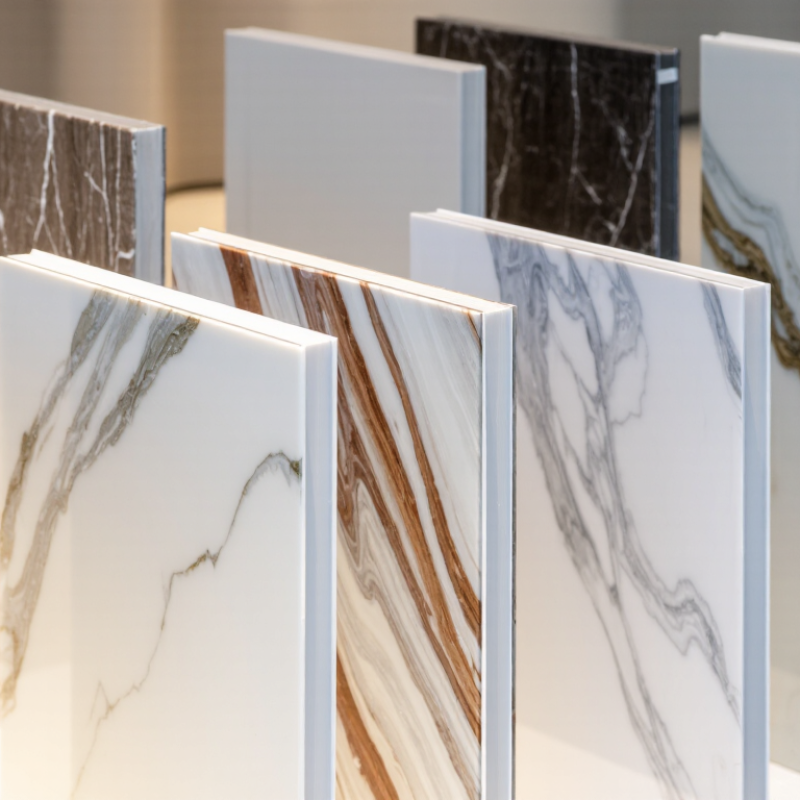
A PVC marble sheet is a decorative panel made mainly from polyvinyl chloride, mineral filler, and processing additives. Its surface carries a printed marble pattern, often protected by a clear film or coating. The exact layers and thickness vary by product. Some sheets have a smooth, cool gloss; others mimic fine stone veins across a matte finish. The European PVC industry’s VinylPlus sustainability reporting notes that PVC is approximately 57% chlorine by mass, with the remainder largely hydrocarbon-based. That helps explain why PVC is a distinct material, not simply plastic-coated stone.
The sheet is lightweight and can be cut to size, making it useful for interior wall finishes and refurbishments. It is not marble. Surface wear, heat resistance, and moisture performance depend on construction, installation, and care, so buyers should review technical specifications rather than rely on appearance alone. I would check the backing, edge treatment, and cleaning guidance before specifying it. Small details matter. Grand View Research estimated the global PVC market at about US$67.5 billion in 2023, with projected growth through 2030; that figure covers PVC broadly, not marble sheets specifically. It signals a substantial material market, but does not prove the quality of any individual panel.
Why Choose PVC Marble Sheet for Global Buyers?
What Is a PVC Marble Sheet? It is a decorative sheet made from PVC and printed or finished to resemble marble, commonly used for interior wall and surface applications.
Commonly offered PVC marble sheet thicknesses include 2.5, 3, 3.5, 4, and 5 mm. Actual product availability and specifications vary by supplier and market; confirm the technical data sheet before selection.
How PVC Marble Sheets Are Made and Designed
PVC marble sheets begin with PVC resin, mineral fillers, stabilizers, and carefully measured pigments. Manufacturers blend these materials until the compound reaches a consistent texture. The mixture is heated and softened through controlled rollers. Color layers then create the marble pattern. Some designs use printed films, while others form veins directly inside the sheet. Both methods require accurate temperature control.
Surface design comes next. Embossing rollers add fine texture, such as polished stone or soft matte grain. A protective coating can improve resistance to moisture, stains, and everyday abrasion. Thickness, flexibility, and edge quality also affect installation results. During factory inspections, quality teams usually check color variation, flatness, surface bonding, and sheet dimensions. A sample may look excellent under bright lights but reveal defects beside a window.
Designers study natural marble before creating a pattern. They vary vein width, direction, and contrast instead of repeating one obvious image. Random movement often looks more convincing. Still, the process is not flawless. Printed veins can appear too regular, and excessive gloss may expose uneven surfaces. That is worth admitting. Global buyers should request full-size samples, technical data, and batch comparisons before placing large orders. Small differences between production batches can affect wall alignment, especially across wide commercial interiors. Good design balances visual depth with practical cleaning, cutting, transport, and installation needs.
Key Features That Attract Global Buyers
PVC marble sheets appeal to global buyers because they combine a stone-like look with easier handling. Their lighter weight can simplify transport and installation compared with many natural stone panels. A sheet with a glossy surface can brighten a hallway, shop counter, or bathroom wall. Patterns vary, so buyers can select veining that suits a specific interior. Real samples help. Screen images can hide color differences.
Tips: Check the sheet thickness, surface finish, and installation instructions before ordering. Ask for a sample and inspect it under the lighting used in the finished room. Small checks can prevent costly mismatches.
For practical projects, consistent dimensions and a clean, even backing matter as much as appearance. PVC marble sheets are generally easy to wipe, which helps with everyday splashes and dust. However, performance depends on product quality, installation, and the conditions of use. Heat, sharp impacts, or unsuitable cleaning products may damage some surfaces. Buyers should confirm care guidance and intended applications with the supplier. One detail is easy to overlook: matching patterns across several sheets may take planning, and the result may still not look perfectly continuous.